You are browsing the archive for Talisker Archives - Miss Whisky.

Alice Lascelles

May 3, 2013 in Whisky Women

 ”There are so many wonderful stories to tell about whisk(e)y – and yet it still remains so very misunderstood. I’m excited by the challenge of trying to change this.” – Alice Lascelles


 Alice Lascelles is the new Sunday Times and Times Columnist on spirits and a founding editor of highly regarded industry magazine Imbibe.

As a whisky lover since a visit to Jura distillery early on in her journalism career, Alice is setting the pace for getting more coverage of the water of life in mainstream media.

In this Whisky Women interview, she speaks about her most memorable dram, what inspires her about whisky and why she agrees with Caitlin Moran that it would be nice to be considered just one of ‘the guys’.


What made you want to write about whisky?

When I began in the drinks world ten years ago I wasn’t immediately drawn to whisk(e)y. Like many people, I thought it was intimidating, cliquey, old fashioned, geeky. But gradually I discovered a different side to it. I learned that it can be artistic and exciting and pretty rock and roll too. It’s a subject that takes you on fascinating journeys all over the world, and has made me all kinds of new friends. It teaches you about science and geography and history and politics. It ignites your imagination and expands your vocabulary. There are so many wonderful stories to tell about whisk(e)y – and yet it still remains so very misunderstood. I’m excited by the challenge of trying to change this.

Do you remember when you first came to like whisky? Was there a dram that hooked you in?

The very first distillery trip I went on as a cub reporter on Wine & Spirit International was to Jura. We crossed by boat – there were seals, whirlpools, George Orwell’s house. I sat by the fireside that evening at Jura House, dram in hand, and thought – yep, this is the life for me. I was completely blown away by the romance of it. My most memorable dram however, was my first taste of Talisker 10, which I had at the 175th Anniversary celebrations on Skye. It was with an oyster straight out of the sea – the combination of flavours was dazzling, and it remains among my all-time favourite drams to this day.

What do you find most inspiring about whisky?

I think a really under-appreciated side of it is the incredible artistry that goes into making whisky – I think most people still think you just punch some numbers into a computer and then pull a lever. The myriad different factors that shape a whisky’s flavour, and the skill of those people whose task it is to manage them is awe-inspiring. I love the fact that no machine has yet been invented which can improve on the human nose. And I find wood in particular absolutely fascinating.

What do you enjoy most about the drinks industry?

It’s populated by people who are really passionate about what they do, and who also enjoy living well. If you’re interested in what they do, they’ll throw open their doors for you.

What frustrates you about how whisky is perceived/spoken about?

Despite the excellent efforts of certain people, I think the industry is still guilty of being very cliquey and jargon-ridden. I’d go so far as to say that some whisky professionals deliberately cultivate that air of impenetrability simply to feed their egos. Whisky is many amazing things, but at the end of the day it’s still just a drink.

I’m reluctant to mention the ‘s’ word – but I’m afraid it’s also still disappointingly sexist. If you happen to be blonde, people always presume you’re the PR person. Only the other day I was sitting next to the CEO of one of the world’s biggest whisky producers at an industry lunch. I’ve been writing about whisky for nearly ten years, am the founding spirits editor of the leading drinks magazine for the UK on-trade and write two weekly columns for the Times Whisky Club and yet he still turned to me and said: ‘So, do you actually like whisky then? I mean, really?’ You’d be amazed how often I get asked that – I’m pretty sure it wouldn’t be the same if I was a man.

What would you like to impart on readers of your column?

Don’t be scared. Have fun. Don’t get so hung up on age statements.

What achievement are you most proud of in your drinks career?

The other day a reader of my Times columns said to me: ‘Your column has made us realise that we are interested in something we didn’t know we were interested in.’ As a journalist, that is the highest praise I can imagine.

Do you feel more women should or could be involved in the whisky industry?

I think not enough is made in the mainstream media and marketing about how many female whisky makers there are – I think people would be very surprised. However I’m absolutely opposed to any special measures designed to include more women in the industry – as Caitlin Moran would say, can’t we just all be ‘the guys’.

How do you think the industry has developed/changed since you’ve been involved?

As a journalist, I’d say the really big change that’s just happened in the last year or two is the increase in spirits coverage in the mainstream consumer media. It’s still criminally small compared to wine, but it’s getting there. I’m very excited to be part of that.

Why would you encourage someone to try whisky?

It’s the start of a fascinating journey of discovery that will last your whole life, which can take you to extraordinary places, introduce you to all kinds of people, and which, perhaps most importantly, you can share with your friends. That conviviality is one of things I love most about whisky. Oh, and it’s bloody delicious.

What is your favourite memory of whisky drinking?

So many – but the best usually happen outside.


To read more from Alice Lascelles, check out her twice-weekly blogs on the Times Whisky Club website: http://www.timeswhiskyclub.com/blog/

Storming ahead? Talisker Storm Review

March 30, 2013 in Reviews

A few weeks back, Talisker released the latest in its whisky line-up, the Talisker Storm.

In follow-up, I spoke with Diageo’s head of whisky outreach, Dr Nick Morgan, about the reasoning behind releasing a non-age statement whisky at this particular time. That piece can be found here.

I’ve now had the chance to sample the whisky a few times to get a better idea of its nuances. I’ve also compared it to the company’s other entry level whisky, Talisker 10, a bottle of which I nicked from a mate who wasn’t particularly fond of it, having come to the decision that no smoky whisky is for him (I’m hoping to change his ways, of course).

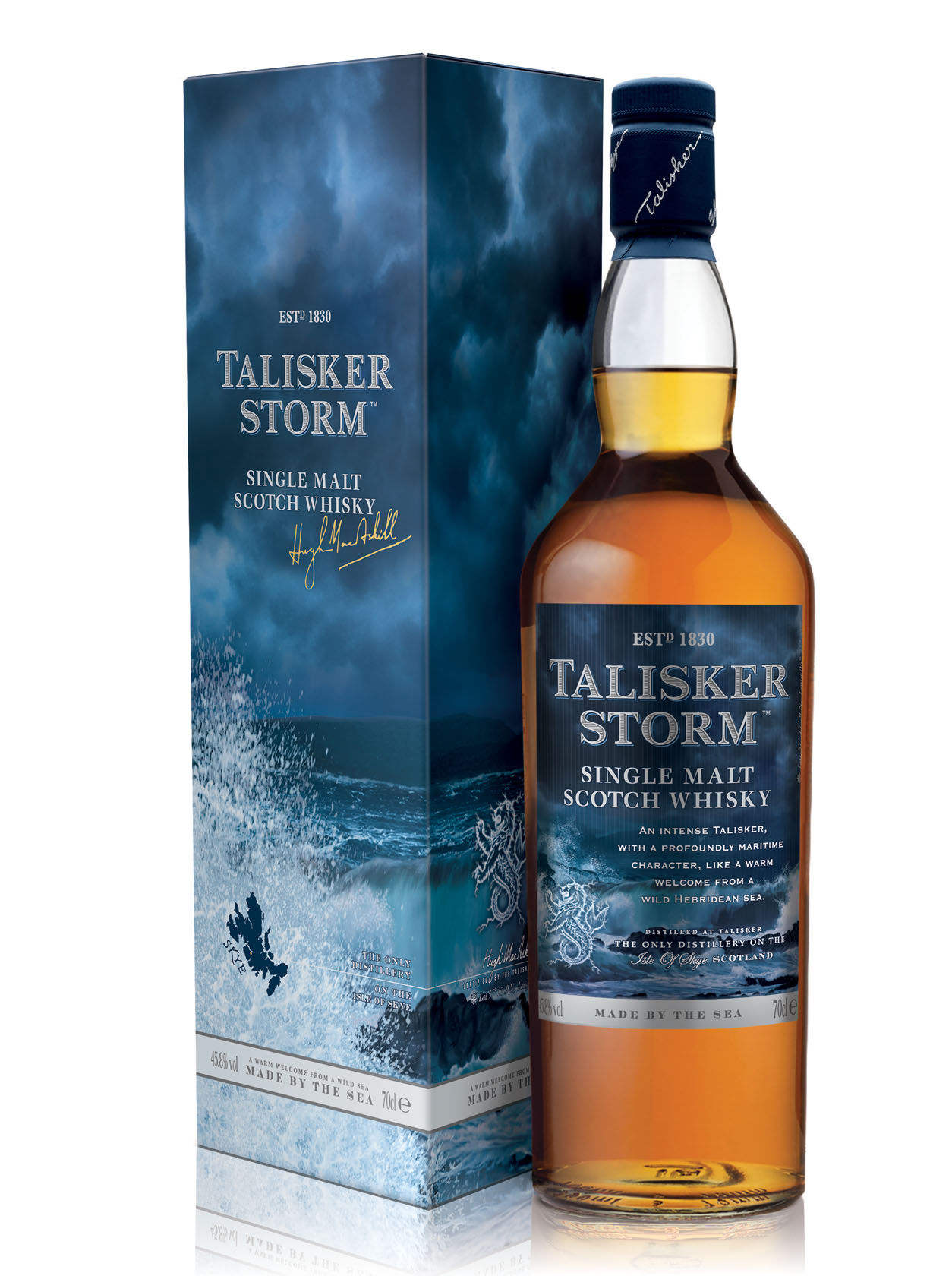
As background, the Talisker Storm is meant to be a sort of big brother to the Talisker 10. It is a non-age statement whisky created from a mix of rejuvinated and refill casks and costs around £40.

The colour is of golden coins and the nose has a great creamy buttery smokiness to it that I found instantly appealing. There’s a slight biscuity sweetness that wafts up at first, followed by lemon and dusty hay notes.

The 10, in comparison, seems more floral on the nose when they’re side by side and slightly lighter in weight (if smells can be weighed?). There is less creaminess and it is surprisingly delicate given I’ve always considered it quite a powerhouse of a dram.

On the palate for the Storm, meanwhile, there was a nice fruity sweetness (stone fruits like apricots, peaches) with a rich chunk of rock salt lingering mid-sip. A dash of vanilla and a hint of fresh blades of grass all walk lightly over the smoky, savoury backbone, making it very satisfying.

Going back to the 10, the palate felt crisper and a bit more refreshing, with that lovely mix of vanilla sweetness, salty brine and earthy smoke.

In the end, it’s hard to say which I prefer. But I can conclude I’d like to keep both in my drinks cabinet. At only £8 more for the Storm, it is still a good buy but I’d recommend sampling them side by side if you can to see which you prefer. Neither are likely to disappoint.


Dr Nick Morgan discusses new Talisker Storm whisky

February 27, 2013 in Interviews, Whisky Releases

Talisker StormRecently, Talisker took the headlines in the whisky world with the release of its new product, Talisker Storm. The whisky is meant to be a bolder step-up from its industry mainstay, the Talisker 10-year old.

As a NAS (no-age statement) release, the news got some tongues wagging about what this means for the future of age-statement whisky and why the Diageo-owned brand has taken this step.

The Storm, which took 15 months to develop, is created from a mix of rejuvenated (more on that later) and refill casks. It will be slightly pricier than the 10-year old, and is currently selling for around £40. It will be joined on the shelves with a second release – the Talisker Port Ruhige (which means King’s or Royal’s Port in Gaelic) within the next quarter.

I spoke with Dr Nick Morgan, Diageo’s head of whisky outreach, to learn more.

Why have you decided to release this now?

If you think about Talisker and the Classic Malts, the original Classic Malts were launched in 1987 – well over 20 years ago. Since then we’ve released a couple of other Talisker expressions – the 18 year old, the Distillers Edition and 57 North – but they’ve all been significantly premium versions. We’ve not launched anything in those 20 years aimed at the pocket of the mainstream Talisker consumer who makes up majority of business.

Why did you decide to go for a ‘bolder’ flavour profile?

With a liquid so distinctive as Talisker, what you don’t want to do is dumb it down. Talisker is wonderful from the commercial or marketing point of view because it really polarises people; some people hate it, some people love it and that’s a great place to be because the people that love it, really love it. If you’re offering them a drink, then you have to offer them something they will love as equally as the already extreme flavour profile of Talisker so that’s why we decided to play with something that’s going to be bolder that will accentuate the maritime characters – it’s really smoky in a way that’s far more Islay like than Skye like, but it also keeps a trademark you find in Talisker which is that fruity sweetness.

It’s available in European markets now. Any plans to release it globally?

When you plan a project like this, you plan for success so the assumption is it will be successful in western Europe and will be rolled out globally.

Some of the whisky in the make-up is matured in rejuvenated casks. Can you explain further?

Every cask has a natural life, at the end of which the wood activity is very low so if you have a cask that is on its third or fourth refill and leave it for ten years not much will happen. It’s not unique to Diageo but something we’ve done a lot of key research on is how you can bring a cask back to life. At our new cooperage at Cambus [near Alloa in south-eastern Scotland] coopers take the ends off the casks and the casks are scraped on the inside so we expose a fresh wood surface in a measured way to release the wood characters we need. After the casks have been scraped they’re then toasted over a gas flame so the fresh oak is charred. The original cask ends are then reunited with the casks and they’re ready for refilling so the cask has another life for up to 30 or 40 years.

Whiskies from rejuvenated casks have a very specific wood character in terms of nose and flavour. And whether you’re talking about putting together a recipe for a single malt or for a blend, it gives you a very specific flavour profile that you can introduce in terms of a variable for the end product. I think we’ll see more of it generally.

Will the trend of NAS whisky releases continue?

I think you will find that brands are going to release more and more expressions focusing on flavour and how that flavour is achieved – whether it’s through special types of wood, or finishing or peat or no peat – is going to be a far more dominate part of the malt whisky narrative over next five to 10 years. I think it reflects a category that is maturing and reflects consumers who are maturing and have a better understanding of what it is that distillers and blenders are trying to achieve when they release new products.

In emerging markets, age is often seen as an important factor because an older item is more expensive and, therefore, more prestigious. Will we see aged whiskies being sold to markets such as Asia and NAS whiskies saved for European markets?

It’s not quite as straight forward as that. I would point towards the huge success in emerging markets of products such as Johnnie Walker Blue Label which has no age statement. And Johnnie Walker Red Label is our biggest selling product and that has no age statement. That demonstrates that the rule is not hard and fast.

However, I think age has a greater part to play in markets where Scotch is not as understood because it gives consumers some sort of indication about what they might be buying and what they might expect. The whole practice of using age statements was about establishing the legitimacy and integrity of products being sold. I think in mature markets in Europe and North America, Scotch has gone way beyond that point. It’s far less relevant for consumers in mature markets than it is for consumers in emerging markets. But even there, with the Johnnie Walker Blue Label, it’s not essential.

Stay tuned to Miss Whisky for a review of the new release, coming soon.

The Queen of Victoria’s festivals

January 7, 2013 in Uncategorized

For Iain Hooey – one of the founders of the Victoria Whisky Festival – the business of putting on a big whisky show could not have gone better over the past seven years.

The festival held at the Hotel Grand Pacific in British Columbia, Canada is about to celebrate its eighth anniversary but it began as a bit of a pipe dream.

According to Iain, he and fellow founder Lawrence Graham – who runs the Whisky Intelligence site and is a Malt Maniac - decided to head to next-door province, Alberta, for a whisky tasting at the Willow Park liquor store in Calgary.

“After a plethora of drams Lawrence asked, ‘Can we put one of these on in Victoria?’” explained Iain, a retired police officer, in a recent phone interview. “So, in that haze, we said that we could put one on but would do it differently.”

After 14 months of planning and with all their ducks coming comfortably together in a row, Iain and Lawrence were able to proceed with the festival, selling 475 tickets that first year – a huge increase on the anticipated 75 tickets they had a goal of shifting.

So what has made the festival stand out since 2006?

Jim Murray at the 2012 festival.

According to Iain, it comes down to four key things they decided to put in place from the start.

The first is that, with Canada’s very strict laws on alcohol consumption, the team chose to offer every guest a ride home after the festival. They managed to pull this off by getting a car hire firm and volunteer drivers on board to ensure the safety of attendees – even those living 30 or 40km away from the venue.

The second decision that helped them stand out was when they decided they would make no profit on the event at all, instead, giving all proceeds to charity. When they were first planning the festival, Iain said they realised they could end up paying for much of the festival out of their own pockets. As it turned out, they still made enough for a charity donation. Last year, $27,000 (or, approximately £17,000) went to two nominated charities. To help run the festival, the charities provide volunteers to take tickets and ensure the smooth running of the show.

The third choice was to not charge drinks companies for tables, a decision which meant many major whisky brands – from BenRiach to Talisker and the Scotch Malt Whisky Society – decided to get involved from year one. Iain said he only asked them for four things: to show up, to have enough stock to cover the festival, to do an engaging masterclass and to stay at the hotel.

And the final option? They were going to stay involved through every process, including selling tickets by hand rather than through an online ticket distributor like Ticketmaster, with some being allocated to local whisky tasting groups.

“We knew whisky clubs would be supportive of the event and that following it, they would buy whisky. We also knew that their buzz would create more buzz and we could move forward with them working with us,” he added.

Sam Simmons, The Balvenie's Global Brand Ambassador.

What happened from there was a continual rise in interest from the local community, visitors from the US and overseas, media attention and support from global whisky brands.

It couldn’t have hurt that Jim Murray – who was a speaker from the first year onwards – also called it “the best organised whisky show in the world.”

“That was an accolade we weren’t looking for and weren’t expecting so we had smiles on for quite a while. We’re proud to say: ‘Look we’re not really big but we’re going to put on a good show,’” Iain added.

This year, there will be the third annual Canadian Whisky Awards – hosted by Davin de Kergommeaux – along with an evening dinner hosted by Cutty Sark and The Glenrothes, along with tastings from Glenmorangie, Springbank, Laphroaig, among many others. The consumer tasting – on Saturday, 19 January – runs in the evening.

The secret to the success, he said, has been bound up in the fact there is little desire to increase the number of attendees and make it an impersonal event. For the 2013 show – which runs from the 17-21 January – around 1,400 tickets have been sold for the consumer tasting on the Saturday night and all 34 masterclasses. This number of tickets is just right, he said, adding it is doable now because of the extensive help from others on the committee – such as Dr Jonathan Adams, who pulls off all the masterclasses in an orderly fashion within a six hour time window.

Canadian whisky on show at the 2012 festival.

But it also means that getting hands on tickets can be tricky – when they go on sale in November, people start lining up at the ticket sales point (local specialty drinks shop, The Strath) at 4am and all tickets are sold within two and a half hours of the shop opening. A growing number of those people buying tickets – or receiving them – are women, added Iain, who said there were only around 6-10 female attendees in the first year, with that number growing to around 20% today.

For Iain, the festival has gone from strength to strength and is something he likely couldn’t have imagined getting involved in  twenty years ago. Back then, he was only keen to collect rather than drink it because he had a feeling it would rise in value one day. This has meant his collection now includes rare gems from a 1962 Macallan to a 1964 Tomatin and a 1963 Longmorn. It took him ten years to really get a taste for whisky.

But after the fateful road trip with Lawrence, there is no looking back. The Victoria Whisky Festival is most certainly a proud bastion for whisky in Canada and I wish all of those going the best of enjoyment!

Photography courtesy of Jen Steele Photography. For more information on the Victoria Whisky Festival, visit: www.victoriawhiskyfestival.com

An Emporium of Whisky Delights

December 17, 2012 in Uncategorized

Colin Dunn looking spooky as a monk.

It was a perfectly normal Monday night in Shoreditch. A small group of people gathered in a cosy back room and listened to monastic tunes while wisps of dry smoke wafted past our nostrils and Colin Dunn (Diageo brand ambassador) told dark tales of whisky history while dressed as a monk.

Like, I said, perfectly normal.

Or, not, if you aren’t used to strange antics of the cocktail bars that haunt this part of London.

This particular evening was arranged by the Worship Street Whistling Shop – a basement bar with gin-palace style and trendy-oddity based on a darkened, office-filled street near Old Street. It was a part of the bar’s new “Whisky Emporium” designed in partnership with Colin.

I was there as a part of a test group to see how the Emporium’s new whisky installation would work. It is the latest in a series of emporiums for the fantastic little bar – following on from a rum and cocktail one done previously. With me were whisky aficionados Karen and Matt from WhiskyForEveryone and Sunday Times drinks columnist and Imbibe editor, Alice Lascelles.

The Emporium is meant to give patrons a fully sensory experience to learn about the history of one particular spirit – in this case, whisky. The evening is divided into six parts, during which scents are pumped in to match the particular theme of the act, and drinks, food, music and video are added in to hit all of your brain’s intake buttons.

As it was a test night, there were more changes and interruptions than would normally be the case but, regardless, it was bizarre and fantastic. Besides, as Colin put it, “This evening is the acoustic version; we’ll be going electric in January.”

We started with Colin dressed spookily as a monk discussing the origins of whisky, and tried a whisky based punch that used ingredients that would have been around hundreds of years ago – such as mead and hay (that’s right, hay). The nutty, cream, apple and honey drink was paired delightfully with dried vegetable crisps.

In act two, to the background of some Miles Davis and John Lee Hooker jazz, Colin ran us through the history of blending. We were then asked to work together as a group to create our own blend. We were allowed to smell each but not know what whisky it was, instead having to rely on our senses to mix them together. Each whisky was given a name of a Scottish celebrity it reminded the team at Worship Street of. One of my favourites was, “Frankie Boyle: Well-oiled fishing net on fire.” We added some cherry-pie Lorraine Kelly and a bit of Billy Connolly spice, creating a fruity, sweet whisky with a bit of warm pie spices.

By act three, we were all really getting into things. So, when Colin came in as “Cooper Dunn” we listened with glee. My favourite cocktail of the night – a bonkers  twist on a blood and sand made from Cragganmore Portwood, grapefruit and pickle brine, that was part sour, part sweet and part briney salt – was served out of individual flasks and combined with the savory prosciutto and bread, to represent a cooper’s lunch. As we nibbled and drank, Cooper Dunn gave us a rundown of the influence of wood, while a subtle woodsmoke blew through the room to further enhance the impact.


Act four covered regions, with whisky jellies placed in teeny glasses and served on a whisky map, while act five looked at the importance of age and included a succulent oyster topped with a lavender foam and a Talisker 57 North-based cocktail. The final stage saw us through to the future – with a backdrop of images of a bustling, bright city at night and uplifting dance music. Here we were served the most innovative cocktail of the night – in the bottom of a tall glass, a coca-cola flavoured Berocca sat, ready to have a Caol Ila whisky and soda poured on top.

The whole night was slightly Alice in Wonderland – but I wouldn’t expect much less from the team that also runs Purl in Marylebone. While there were some niggles to be worked out (for instance, the need for stronger scents to be pumped through to up that sensory experience) it will inevitably be a sell-out event for the whisky-curious. And a worthwhile one at that. You may never see Monday night in the same way again…!

The Whisky Emporium will run nightly for three months, for groups of at least four at a cost £90 per person. For more information, visit: www.whistlingshop.co.uk

Talking to Talisker

May 19, 2012 in Uncategorized

When Mark Lochhead started in the whisky industry in the late ’80s, the world was a different place. There were no bloggers, like yours truly; no iPhones or Internet; the Berlin Wall still stood; the idea of climate change and a black US president were still light years away. And, single malts were still, well, the small fry.

“When I started, single malts were a very small area. At the time, you had Glenfiddich and a few others,” said Mark, now the distillery manager at Talisker. “And you didn’t have the forecasting you do now. You either had too much or too little. It was very different.”

Mark has been at Talisker for three and a half years, having started at J&B in 1987 as a blending clerk after randomly getting involved.

“It was a very happy accident,” he explained. “I was 21 and I doubled my wages overnight and got a bottle of whisky every month. It didn’t take long until you realised what a great industry it was.”

He worked his way through the ranks as a head of inventory administration, then to learning recipes and blends in the lab. He moved to Clynelish in 2005, before coming to Talisker in 2008. Over that time, he says the dramatic shift in demand for single malts has been incredible.

“There’s a big change in the air. Whisky growth is phenomenal,” he added, during an interview at the distillery.

This was partially started – he believes – during the late ’80s and early ’90s when the tourism industry began to grow and more people began visiting distilleries. Talisker’s visitor centre – which once got 15,000 visitors a year at a push – is now bursting at the seams with 55,000 global guests every year. It is in the midst of an expansion of its visitor centre to keep up with demand without making tour groups too large.


From his office – which overlooks the dramatic Isle of Skye landscape and misty Loch Harport – it’s easy to see what lures visitors to this volcanic, rocky outpost. Skye is magical and, as Mark believes, so is the whisky.

“There is still a wee bit of magic in production,” he said, as he took my partner and I around the distillery.

While Mark is the man to talk to if you want to know about Talisker’s production, he equally admits the beauty in not knowing everything that goes on in the stills as the rich liquid becomes what will later be a quality dram.

Talisker – which uses peated barley from the Black Isles – is the only distillery in Scotland, according to Mark, which has an odd U-bend in its stills, making for a longer “copper conversation” with the wash, which then creates the distillery characteristic of a lighter, fruitier flavour, despite its peatiness.

Back in the office over a few drams, Mark told us he considers this the most exciting time for the Scotch industry while equally knowing one musn’t get ahead of oneself.

“You’ve got to appreciate the likes of Japanese whisky, which has really come on. And Irish whiskey has got a big push right now. You have to respect your competitors. We’re [as an industry] particularly proud but we’re not arrogant. But if you rest on your laurels, that could change.”

Over the next two to three years, he says he wants to make sure he keeps up with demand so that “come the time and day, Talisker is ready to be sold.”

Equally, he has ambitions to push the brand higher up in the market.

“I’d like to get it back into the top 10. And, I’m not trying to overtake Glenfiddich or anything. But I want to make consumers admirers of Talisker,” he added.

The hardest market to convince might just be Scotland, which Mark says disappoints him with it lack of appreciation over the product.

“There’s big expansion and all these good news stories are out there. But in Scotland, whisky is taken as something that has always been there. It doesn’t set the heather on fire,” he said.

But, he hopes with all the international attention this boom will last.

“It’s the one thing that’s bucking the [recession] trend. Hopefully the bubble won’t burst. But, the figures come in and they’re consistent and much higher than expected,” he said.

And, unlike the sub-prime mortgage market, at least the Scotch industry is producing something of quality.

“In my 25 years, I’ve very rarely tried something that I thought was not good. Whisky is a very high quality product,” he concluded.

One can only begin to guess what the next 25 years will bring…


Hannah Lanfear speaks to Miss Whisky

May 14, 2012 in Uncategorized


Today on Miss Whisky, I speak to Hannah Lanfear, the bars manager at Boisdale of Canary Wharf, where she has been responsible for choosing many of the bottles which are a part of the 800 whiskies on offer at the restaurant. She speaks about getting into whisky, her love of Talisker 1981, 20-year old, and why she enjoys what she does so much. Click here to read the full interview.

Belated Burns Night Thanks

February 3, 2012 in Uncategorized

Burns Night. That phenomenal night on the whisky calendar when people from all corners of the globe get together to eat sheep’s intestines, listen to strange Scottish warblings and dance the night away!

This year I attended my very first (aww) PROPER Burns Night. But, due to being rather swamped off my whisky-loving feet of late, I’ve had hardly any time to send out the massive thank-yous that should be given to those who made sure I was no-longer a Burns Night virgin.

So, before it gets far too belated, I must thank the chaps at The Whisky Exchange for putting on a darn good show over at Vinopolis – 200 people filled the cavernous stone hall and reveled in the fantastic musical accompaniment from License to Ceilidh, chatty banter of Simon & Franchi from Simply Whisky and whisky sponsored by the fabulous folks over at Chivas Brothers. Thanks also goes to photographer Simon Hanna for capturing it all!

The evening began with a bit of particularly good piping and a feisty cocktail of apple, cinnamon and Chivas Regal 12 to get us warmed up. Once settled in the opulent halls, we sat back and listened to (or tried to – I’m still not British enough to fully comprehend thick Scottish accents) Simon & Franchi’s energetic poem reading and speech making in honour of Mr Robbie Burns.

Then came the food and whisky! We started with a lovely Cock-a-Leekie soup, partnered with the delicious Scapa 16. I had not tried either and was delighted with the whisky. Its saltiness and citrussy hints married well with the creamy soup and was a perfect way to begin.

During more incomprehensible (though I’m sure very funny) toasts from the hosts, we moved onto the pièce de résistance…the haggis! The last time I tried this beautiful stuff had been three years ago at an event at Stirling Castle (certainly something to see). My other half (we’ll call him Mr Whisky) had never tried it (despite having loads of Scottish roots) so it was a treat all around.

The haggis was partnered with the Isle of Jura 16 – not my favourite in the Jura roster, but a nice match nonetheless with the slight smokiness and refreshing bite working well with the heavy main.

Finally, we moved on to the dessert – though by this time I was too full to take in much more. I do remember it was a suet pudding but I only managed a couple of bites, opting instead for more whisky! The Glenfiddich Rich Oak 14 year old that came with the dessert was tasty though also not my favourite Glenfiddich. The super oak whisky was a bit too sweet for my liking as well after all that heavy food.

We finished with the Talisker Distiller’s Edition – it was meant to be drunk with coffee but I didn’t want to be buzzing all night, so I stuck, instead, just to the whisky. Not that I could complain. Extra whisky? Me? Never! It was a nice, spicy coastal dram and my choice of the evening.

Then as some crazy people decided to take to the floor to dance, I sat back and enjoyed the rest of the evening watching people fling each other around to the incredible tunes of Licence to Ceilidh. I was far too full and sleepy to join in but it was a great spectacle all around!