You are browsing the archive for film Archives - Miss Whisky.

Crafty Angels of Whisky

May 15, 2013 in Reviews

The Angels' ShareFor those of you that drink whisky regularly, you will likely have come across the story of the Angels’ Share. But for more casual whisky drinkers, let me explain.

Each and every year, every cask in every warehouse from Scotland to Ireland and India loses a certain portion of whisky from evaporation. In Scotland, where the temperature is cooler, it’s around 2-3%. In India, where it’s hot, hot, hot, about 11-12% disappears annually.

This chunk of missing whisky is affectionately referred to as The Angels’ Share because it is the angels that get the benefits of this natural process. This is also the title of a fantastic Ken Loach film from last year, which I highly recommend you check out and which I reviewed here.

Recently on Twitter, I noticed a company called @Angelshareglass. Curious, I followed them and I soon received an email from the affable founder Karen Somerville about what they were doing.

Her father, Tom Young, is a master glassblower, with more than 50 years of experience in the field. The pair decided to start a business called Angels’ Share Glass to honour one of the Scottish whisky industry’s most fabled tales by designing hand-blown glass angels, whisky droppers and stirrers, among other things, based on the idea.

In a recent interview, Karen explained to me their reasoning for doing so.

“We checked that no one else had ever done it before and thought this is as well known a Scottish fable, as say, the Loch Ness monster, so why hasn’t anyone captured it? That’s when we thought we better get this idea protected and registered the design. All distillers talk about The Angels’ Share on their tours,” she told me.

I received one recently and was really enamoured with it. In a special process that Tom knows, the glass blown angel is filled with a few drops of whisky and then sealed up afterwards. She’s delicate, classy and a proper example of craft-work to watch over my whisky collection.

Tom Young and Karen Somerville

The way the pieces are made, Karen said, is different than normal glassware.

“Kiln glassblowers or crystal makers use very soft and molten liquid like glass. We use a very strong and tough glass usually found in laboratory glass (Pyrex). It takes a very sharp hot flame to melt it but at the same time you can hold the rest of the glass cold. As the business grows we hope to train new glassmakers and keep this dying skill very much alive,” she said.

And the angels even have a celebrity tie-in, with many of the people behind The Angels’ Share film having one in their possession now too, including its famed director.

“Paul Laverty, The Angels’ Share co-writer’s sister in-law has a daughter at my sons’ primary school & one of my school friends is cousins with star Paul Brannigan. We wanted to send them one and we couldn’t have sent one to them without Ken getting one too. He sent a really lovely postcard back to us saying how much he loved it,” she added.

For more information on Angels’ Share Glass and Tom Young’s work, visit: www.angelsshareglass.co.uk

Balblair: Capturing a Moment in Time

July 24, 2012 in Uncategorized

Every once in a while, I find myself utterly entranced by a whisky. For a magical moment, the room around me goes still, my chattering brain slows and I sit silently in wonderment. It’s rare but, when it happens, it can transport me far away – such is the power of a truly amazing dram.

And so, it was while I sat in the time capsule room at the Balblair distillery that I found myself floating off to a warm meadow in the middle of summer. In my hand sat the brand’s new release, the 1969 vintage.

But it was so much more than whisky in a glass. In it, I found myself listening to the tip-toeing of meadow deer, feeling the gentle depth of summer sunshine heating my cheeks, smelling the bristly, dusty notes of animals and drying wheat. Another sip reminded me of eating liquid honey sticks, the gentle waves of sweetness undulating over my tongue. Then bursts of butter melted on white bread, pain aux apricots and orange bitters created a summer brunch in my mouth before everything finished on a flourish of smoked salmon.

I sat, mesmerised, for a good 15 minutes. When finally I came to, I realised my distillery visiting compatriots had left the room and the table was being set, the staff moving delicately around my hypnotised frame.

It’s those moments that I note down, that I associate with the power of the delicate beauty of this subtle drink.

I had come up to Balblair that morning. An overnight train with 10 journalists ensured there was much whisky drunk before we’d even set foot at the distillery; a breakfast of bacon rolls, paracetamol and drams meant I was soon back in the swing of things.

Balblair is one of those places that make you smile for its loveliness. It’s in its own sphere, hidden on the shores of the Dornoch Firth. It’s so beautiful that director Ken Loach decided to set part of his latest film, The Angels’ Share, there. If you didn’t catch it in cinema, definitely watch the DVD. There’s a reason it won the Jury Award at Cannes this year.

Owned by InterBev subsidiary Inver House Distillers since 1996, Balblair turned the industry standard of age statements on its head in 2001 when it began to only sell vintages. These are named by the year they were made, not by the fact they are 12, 15 or 21 years old. The company tries to release at least one new vintage every year, but says it rules itself by the idea of ‘vintages timed to perfection’ meaning the whisky tells them when it’s ready, not the other way around and doesn’t come out of that cask until master distiller John MacDonald declares it to be done aging.

The day of our visit, John was on hand to take us around the distillery. We were also joined by acclaimed whisky writer and personality, Charlie Mclean, who also appears in the film as a whisky expert. Despite the rainy day, I was keen to wander around the site and learn just what the distillery – which has been on its current site since 1894 – had to offer.


The water for the whisky comes from 4.5 miles away, and is gravity fed to the site. The distillery did floor maltings up until 1975, but now has its malt delivered from Cawdor in Nairn.

Inside, amongst the heady smell of yeasty brew, one finds six wooden washbacks made from Oregon pine, all of which were replaced as new in 2001. To the mash, John said he adds 21 litres of liquid distiller’s yeast that bubbles and spits for a 50 hour fermentation period. Finally, in the still room one finds stocky, wide copper stills that do a three and a half hour distillation.

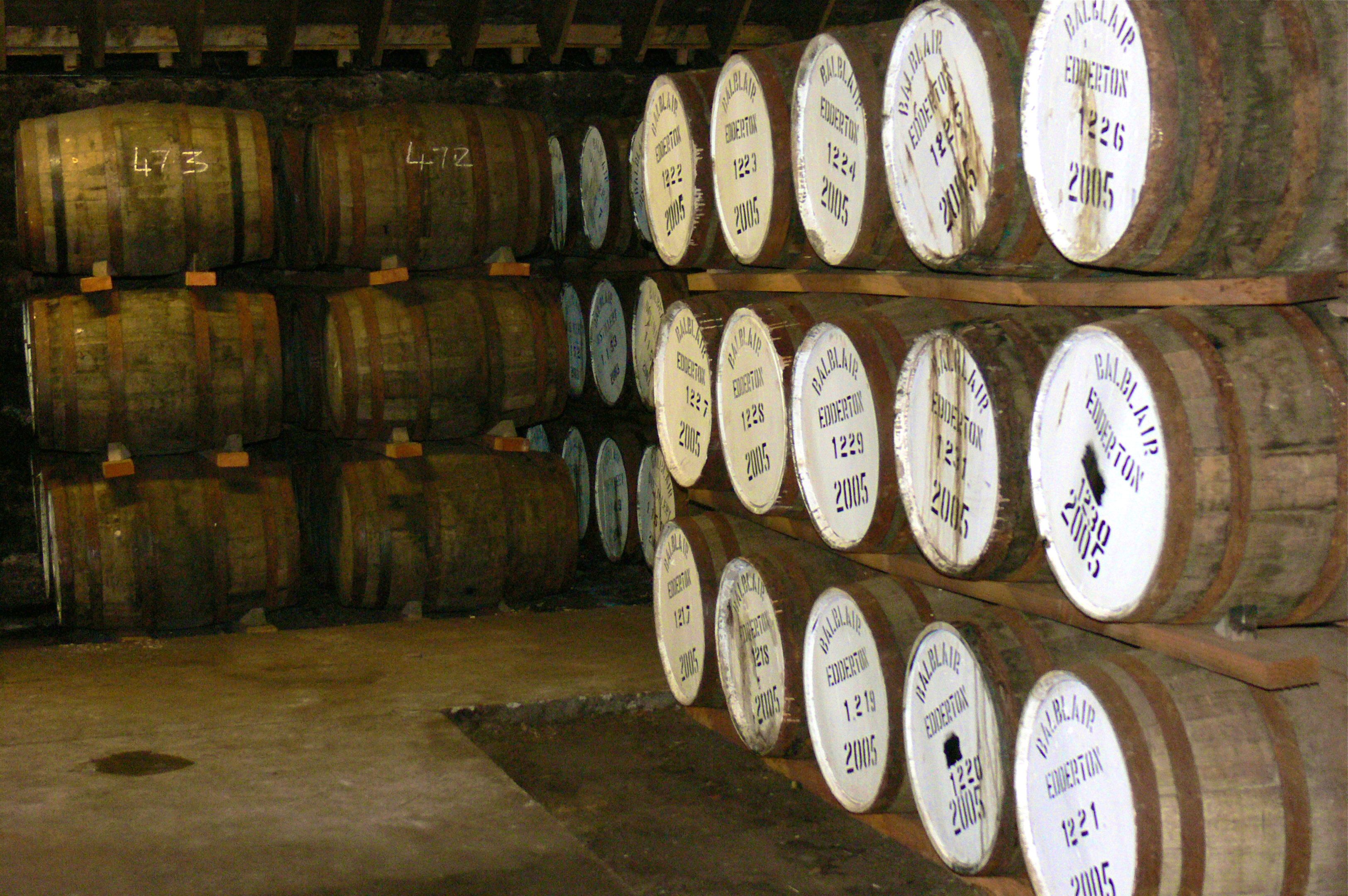
Balblair has eight warehouses on its site, in which sit a beautiful selection of 26,000 casks, 97% of which are first or second fill bourbon, the other 3% of which are sherry casks made from ex-European and American wood. It’s, most certainly, an alluring sight.

Since John was faced with lots of questions from us nosy journalists, it was refreshing to see him answer our ramblings in a relaxed and honest manner. He is obviously passionate about what he does (which most master distillers tend to be) but he comes with a genuine love of it that would be hard to fake.

When asked how he felt about the company’s reliance on vintages, he said: “It’s not marketing BS. There’s no way I’d put my nose or name out there for something that wasn’t a good whisky. I’m not a good liar.”

Fair play, I thought.

But visiting the site wasn’t the only part of the day. There was also the additional opportunity to do my own hand bottling (!) which visitors can also participate in. I am now the VERY proud owner of bottle number 3 of a 1992 vintage from cask number 74.

After all of the enjoyment of visiting the site, it was time to try some of the whiskies. The company’s current standards (2001, 1989 and 1978) are to be replaced by new vintages from 2002, 1978 and 1969, all of which I review here.

It was a wonderful distillery visit and one that will live in my memory for a long time. Perhaps appropriately, I later learned that from the distillery one can see the Clach Biorach, an ancient standing stone that was “used to mark arrival and passage of special moments in time”. Trying the 1969 vintage was, most definitely, a special moment in my whisky tasting repertoire and made all the more magical by the surrounding significance of history that is a part of this place.